 Phone: +86 21 57674551
 E-mail: sales@chenpinsh.com
![Y5[98K8IZ$]AE`8_~L02Q{5](https://cdnus.globalso.com/chenpinmachine/Y598K8IZAE8_L02Q5.png)
Investing in a food production line is a high‑stakes decision—choose wisely, and you secure both capacity and quality; choose poorly, and you risk wasted time, capital, and missed market opportunities. In this edition, we take you through a comprehensive deep dive into tortilla production lines—covering market prospects, equipment selection, quality control, and capacity validation—step by step.

How does the tortilla market look going forward? What products can one line make?
Tortilla is a staple food that has taken the world by storm. In terms of market coverage, tortillas have now reached over 190 countries across the globe, with a consumer footprint spanning the Americas, Europe, and Asia-Pacific—making it a truly global staple.
A complete tortilla production line typically includes the following process stages:
Dough dividing → Ball rounding → Basket proofing → Dough ball conveying → Hot pressing → Baking → Cooling conveying →Counting & Stacking → Packaging
Chenpin's tortilla production line is suitable for a wide range of flatbread products, including tortilla wraps (vegetable-flavored and multigrain varieties), chapati, taco shells, and more.

Chenpin Tortilla Production Lines: Models & Capacity Selection Guide?
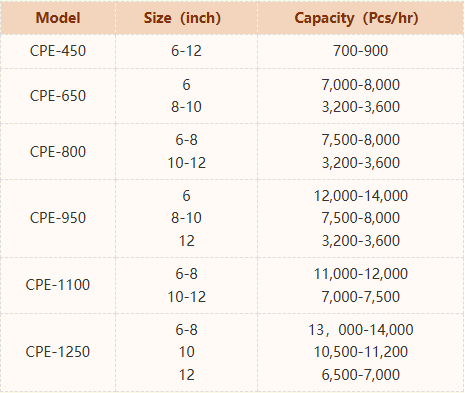
Since the launch of the first Chenpin tortilla production line in 2016, the series has undergone multiple iterations and now offers a complete product matrix ranging from the CPE‑450 to the CPE‑1250.
CPE‑450 – Designed for laboratory R&D and small‑batch trial production, offering exceptional flexibility.
CPE‑650 – Ideal for starting with small‑scale capacity or initial batch production of a single specification.
CPE‑800 – Primarily designed for 8‑inch tortillas, while also accommodating small‑ to medium‑size production needs.
CPE‑950 – Focused on 10‑inch tortillas, delivering balanced capacity with outstanding cost‑performance.
CPE‑1100 – Specifically engineered for high‑output production of 8‑inch tortillas, making it the preferred choice for large‑scale, efficient manufacturing.
CPE‑1250 – The latest model, excels in the efficient and stable production of 10‑inch large‑size tortillas, and is the top choice for mass production of large‑diameter flatbreads.
Selection Guide
When choosing the right model, the primary criterion should be your target daily output for the flagship product size. Note that production efficiency varies by tortilla size—smaller sizes yield higher output, while larger sizes require longer pressing and baking times, resulting in reduced capacity. Chenpin offers one‑on‑one consultation and customized solution assessments based on your specific requirements, ensuring that the equipment configuration precisely matches your production goals.

Tortilla Common production issues & solutions Common problems in production – and how to fix them?
Q1 – Cracking/Blistering on the Tortilla Surface
Root Cause: Excessive press temperature or overly long hot-pressing time, causing excessive moisture evaporation from the dough surface.
Solution: Lower the press temperature or shorten the hot-pressing time to ensure proper cooking while retaining adequate moisture.
Q2 – Irregular (Out‑of‑Round) Shape
Root Cause: Unsuitable moisture content in the dough formula, or poor transition between conveying and sheeting/molding stages, leading to misalignment or uneven pressure distribution.
Solution: Optimize dough hydration to improve extensibility; adjust the transfer parameters between the conveyor and the pressing mechanism to ensure smooth and centered dough feeding.
Q3 – Stacking Sticking (Tortillas Sticking Together)
Root Cause: Insufficient cooling before stacking, with surface temperature or moisture content still too high.
Solution: Ensure the cooling conveyor is long enough, or lower the cooling temperature, so that tortillas reach the proper temperature and humidity before entering the stacking station.
Q4 – Inconsistent Tortilla Sizes
Root Cause: Variations in dough portion weight, insufficient flatness of the pressing plates, or lack of regular calibration of the hot‑press parameters.
Solution: Regularly calibrate the hydraulic system to maintain stable pressure output; simultaneously check and improve the accuracy of the dough dividing process to ensure uniform dough ball weight.
Q5 – Tortilla Shrinkage (Retraction After Pressing)
Root Cause: Excessive gluten strength in the dough, or insufficient proofing/resting time, leaving the gluten insufficiently relaxed.
Solution: Optimize the flour blend ratio or extend the proofing/resting time to allow complete gluten relaxation and reduce internal retraction stress.
Chenpin’s tortilla production lines are equipped with precision control systems that effectively prevent the above quality issues, ensuring consistent roundness, uniform color, and stable texture in the final product.

Can the equipment achieve its nominal production capacity in real-world operation?
Yes, it can.
The rated capacities of all CHENPIN equipment are validated through continuous testing in real production environments—not merely theoretical calculations from the lab. In our turnkey plant solutions tailored for leading food manufacturers across China, actual stable production output has reached 14,000 tortillas per hour on our production lines.
Moreover, CHENPIN has partnered with numerous well-known food companies worldwide, achieving stable mass production with product quality and equipment reliability recognized internationally.
That said, actual output may vary slightly depending on factors such as raw material characteristics, operator proficiency, and onsite environmental conditions. To maximize the success of your production launch, Chenpin provides systematic operator training and on-site commissioning support prior to delivery, ensuring that your line operates at peak performance consistently after startup.
If you have any further questions or specific project requirements, please do not hesitate to contact us.
Phone: +86 21 57674551
Email: sales@chenpinsh.com
Website: www.chenpinmachine.com
Address: No. 61, Lane 129, Dongshe Road, Dongjing Town, Songjiang District, Shanghai, China